- Mon. - Fri.: 8:30 a.m. - 5:00 p.m.
Controlled documents, document control, and document management are integral parts of quality management. They contribute to standardization and can play an important role in ensuring that business processes comply with legal requirements. They also make day-to-day work in quality management easier.
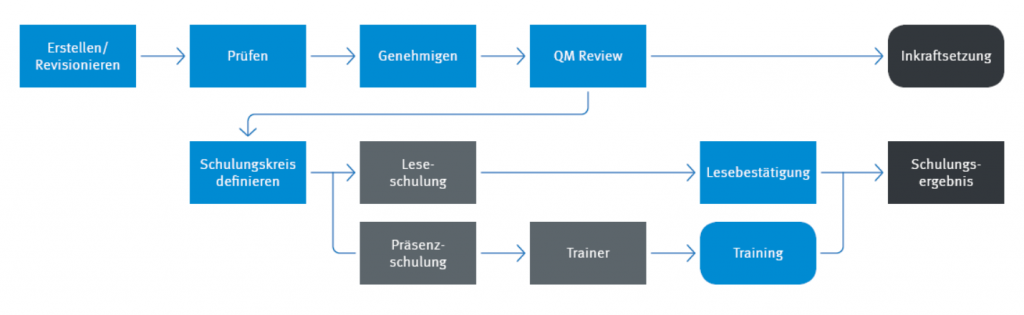
Document control, or controlled documents, covers the entire lifecycle of a document (creation, versioning, archiving) and defines how documents are created, edited, reviewed, approved, and distributed within an organization. ISO 13485 distinguishes between document control and record control, whereas ISO 9001 groups both under the term “documented information.” Overall, however, it can be said that documents represent the entirety of a company’s knowledge. Document control is essential to ensure that the company does not work with outdated documents.
Document control plays a key role, particularly for certified companies, since compliance with certification requirements is verified by external auditors at regular intervals. To ensure effective document control, five essential steps are recommended:
The benefits of automated document management are obvious, even if not all aspects can be fully automated. Despite certain limitations, many processes and related tasks can be easily automated. Document management systems already offer comprehensive features for this purpose.
Proper document control is essential, particularly for certified companies, to standardize and continuously improve processes. Clear structures and well-defined processes enable employees to quickly find and use the documents they need, which saves time and increases productivity. Likewise, a well-maintained document control system reduces the risk of information loss, incorrect decisions, or legal consequences resulting from incorrect or incomplete documentation.
The goal of document management is to systematically manage documents throughout their entire lifecycle. This ensures that all important information related to your company is consistently and reliably documented and retained.
The important thing to note here is:
Generally speaking, document control refers to all important documents used within a company or organization. These include, among other things, quality guidelines, process instructions, work specifications, reports, minutes, contracts, and other documents necessary for the smooth operation of the business, compliance with legal requirements, and the traceability of actions. Each company decides individually which specific documents are subject to this control.
For companies with complex requirements or a high volume of documents, document control software—or controlled document management—is virtually indispensable. It saves time, reduces errors, and ensures transparency and security. In small organizations with low complexity, manual systems may be sufficient as long as they are carefully maintained. However, as the number of documents increases, this may result in an ever-greater workload.
A document is considered controlled if all steps—from creation and review to distribution and archiving—are regulated and documented in a traceable manner.
Depending on the company, specific document managers (e.g., quality managers) or specialized departments may be responsible for maintaining and ensuring compliance with the guidelines. It is important to designate these individuals and to communicate this information accordingly.
Through training, clear guidelines, transparent processes, and regular reviews, you can ensure that employees follow the instructions that apply to them. Furthermore, the instructions should be easy for employees to understand.
Old versions are archived to ensure that only the most current documents are in circulation. However, archiving allows users to still access outdated versions when necessary.