- Mon. - Fri.: 8:30 a.m. - 5:00 p.m.
E-invoicing will become mandatory for B2B transactions starting in 2025. Under the e-invoicing requirement, companies must henceforth create and process their invoices in a specific digital format.
But what does that mean in practice? How can you best prepare yourself and your company for this transition? In this article, we’ll cover the most important aspects of the e-invoicing requirement—from the legal requirements and deadlines to the specific challenges and the opportunities this transition offers.

An e-invoice is a digital invoice created in a structured format that can be sent and received electronically. This enables automatic and electronic processing without media breaks (i.e., the transition between digital files and paper, and vice versa).
Invoices that are sent in another electronic format or on paper and then scanned, however, are not considered e-invoices. Similarly, an invoice sent by email in plain PDF format is not considered an e-invoice.
Starting January 1, 2025, all B2B companies in Germany must comply with the e-invoicing requirement. This means that companies must create, transmit, and receive their B2B invoices in a structured, machine-readable format to enable electronic processing. The only exceptions are small-amount invoices under 250 euros, such as gas station receipts or entertainment expense receipts.
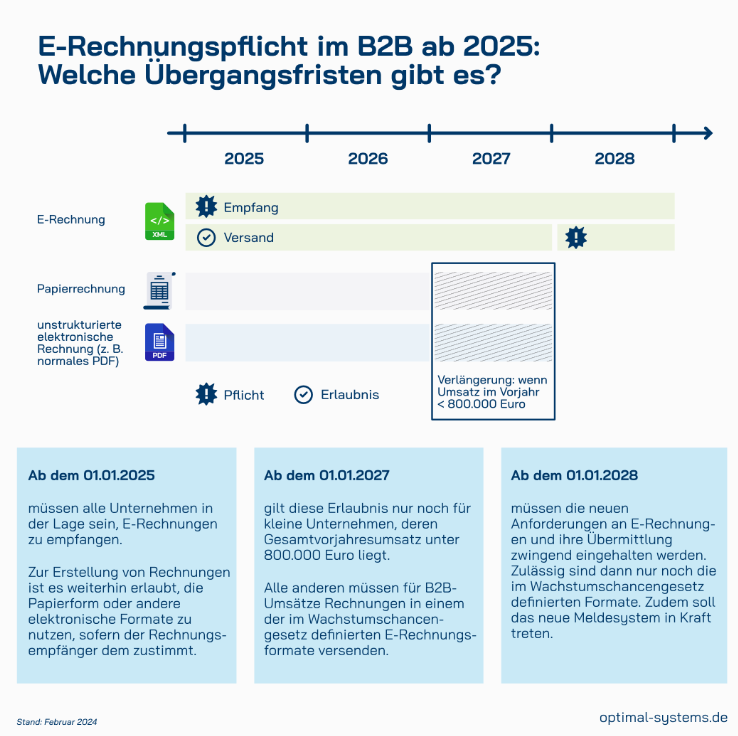
In general, starting January 1, 2025, all companies will be required to receive and issue electronic invoices (e-invoices). However, there are transition periods for implementation to accommodate the significant effort involved in the transition. These periods have not yet been finalized and are therefore subject to change. The following deadlines are currently planned:
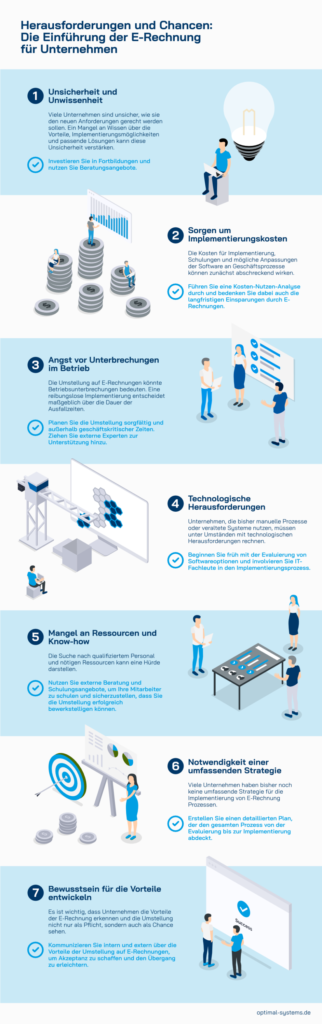
Many companies are unsure how to meet the new requirements. A lack of knowledge about the benefits, implementation options, and suitable solutions can exacerbate this uncertainty.
Solution: Invest in professional development and take advantage of counseling services.
The costs associated with implementation, training, and any necessary adjustments to the software to align it with business processes can seem daunting at first.
Solution: Conduct a cost-benefit analysis, taking into account the long-term savings from e-invoicing.
The transition to e-invoicing could result in business disruptions. A smooth implementation is a key factor in determining the duration of any downtime.
Solution: Plan the transition carefully and schedule it outside of business-critical times. Enlist the help of external experts.
Companies that currently rely on manual processes or outdated systems may face technological challenges.
Solution: Start evaluating software options early on and involve IT professionals in the implementation process.
The search for qualified personnel and the necessary resources can be a challenge.
Solution: Take advantage of external consulting and training services to train your employees and ensure that you can successfully manage the transition.
Many companies still do not have a comprehensive strategy for implementing e-invoicing processes.
Solution: Create a detailed plan that covers the entire process, from evaluation to implementation.
It is important for companies to recognize the benefits of e-invoicing and to view the transition not only as an obligation but also as an opportunity.
Solution: Communicate the benefits of switching to e-invoicing both internally and externally to build acceptance and facilitate the transition.
Overall, the introduction of e-invoicing could present a challenging but rewarding task for companies that were not previously prepared for it. Gathering targeted information, providing training for employees, selecting suitable solutions, and developing a comprehensive strategy are key factors for a successful transition.
The transition to e-invoicing offers companies the opportunity not only to meet legal requirements but also to optimize their internal processes and improve efficiency. This is where Enterprise Content Management (ECM) comes into play in the context of invoice processing.
ECM enables the structured management of electronic documents and data, including e-invoices. By integrating ECM, companies can automate their invoicing processes, efficiently capture and process data, and make it easier to access and search for relevant information.
In addition, an ECM system offers the opportunity to optimize other business processes as well. Use the introduction of e-invoicing as an opportunity to rethink your entire document management and information logistics. By centrally storing and managing digital documents, you can improve collaboration, reduce search times, and increase the traceability of processes.
By incorporating ECM into your e-invoicing strategy, you can not only meet legal requirements but also modernize your entire operation and gain a competitive edge.
It is important for companies to prepare for these changes in a timely manner and make the necessary adjustments to their systems and processes. If many companies wait until shortly before the deadline to plan and organize their IT projects, this could lead to an overload for IT service providers—and result in the requirements not being met on time.
Start planning and implementing the change now. Create a detailed project plan that includes all the necessary steps leading up to the full transition to e-billing. In doing so, you should consider not only the technical aspects but also employee training and the adaptation of your internal processes.
In the future, companies will process and store more data in digital form. While this can offer benefits in terms of efficiency, accuracy, and transparency, it also requires careful data management and security. Use the introduction of e-invoicing as an opportunity to review and improve your data management and security practices.
Send us a message!